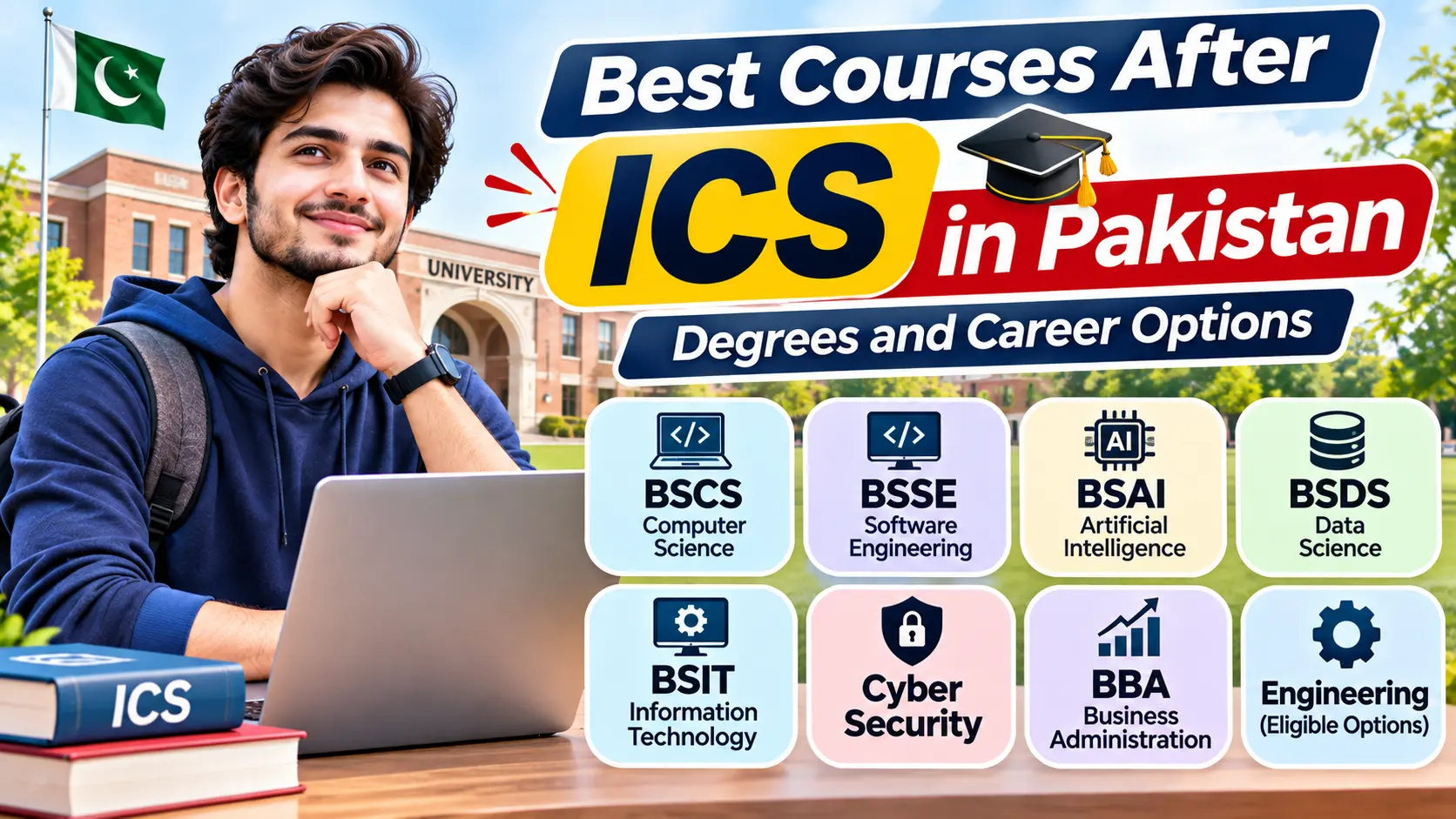
Best Courses After ICS in Pakistan: Degrees and Career Options (2026–2027)
Completed your Intermediate in Computer Science (ICS) and wondering what to study next?
Choosing a university degree after ICS is an important decision. Some students want to become software engineers, others are interested in artificial intelligence, cybersecurity, or data science. Many are unsure whether they can choose engineering, business, mathematics, or another field.
The good news is that ICS students in Pakistan have several undergraduate degree options, and their choices are not limited to computer science.
However, selecting the right course requires more than choosing a field because it is popular. You should consider your interests, mathematics ability, university eligibility, education costs, and long-term career goals.
In this guide, we’ll explore the best courses after ICS in Pakistan, their typical duration, admission requirements, career opportunities, and the differences between major computing degrees.
We’ll also explain how to check whether a university and its degree programme are recognized or accredited before paying admission fees.
What Is ICS in Pakistan?
ICS stands for Intermediate in Computer Science. It is a two-year Higher Secondary School Certificate (HSSC) programme offered through Pakistani intermediate education boards.
The programme provides an academic foundation in computer science and mathematics, along with other subjects depending on the combination selected.
Common ICS subject combinations include:
- Mathematics, Physics, and Computer Science
- Mathematics, Statistics, and Computer Science
Students also study compulsory subjects according to their examination board’s requirements.
Your subject combination can affect your eligibility for certain university programmes.
For example, universities may accept ICS students with Mathematics into computing degrees, while some engineering programmes specifically require Physics.
Important: The eligibility requirements of each university and programme must be checked separately. Having an ICS certificate does not automatically qualify you for every degree.
Best Courses After ICS in Pakistan: Quick Comparison
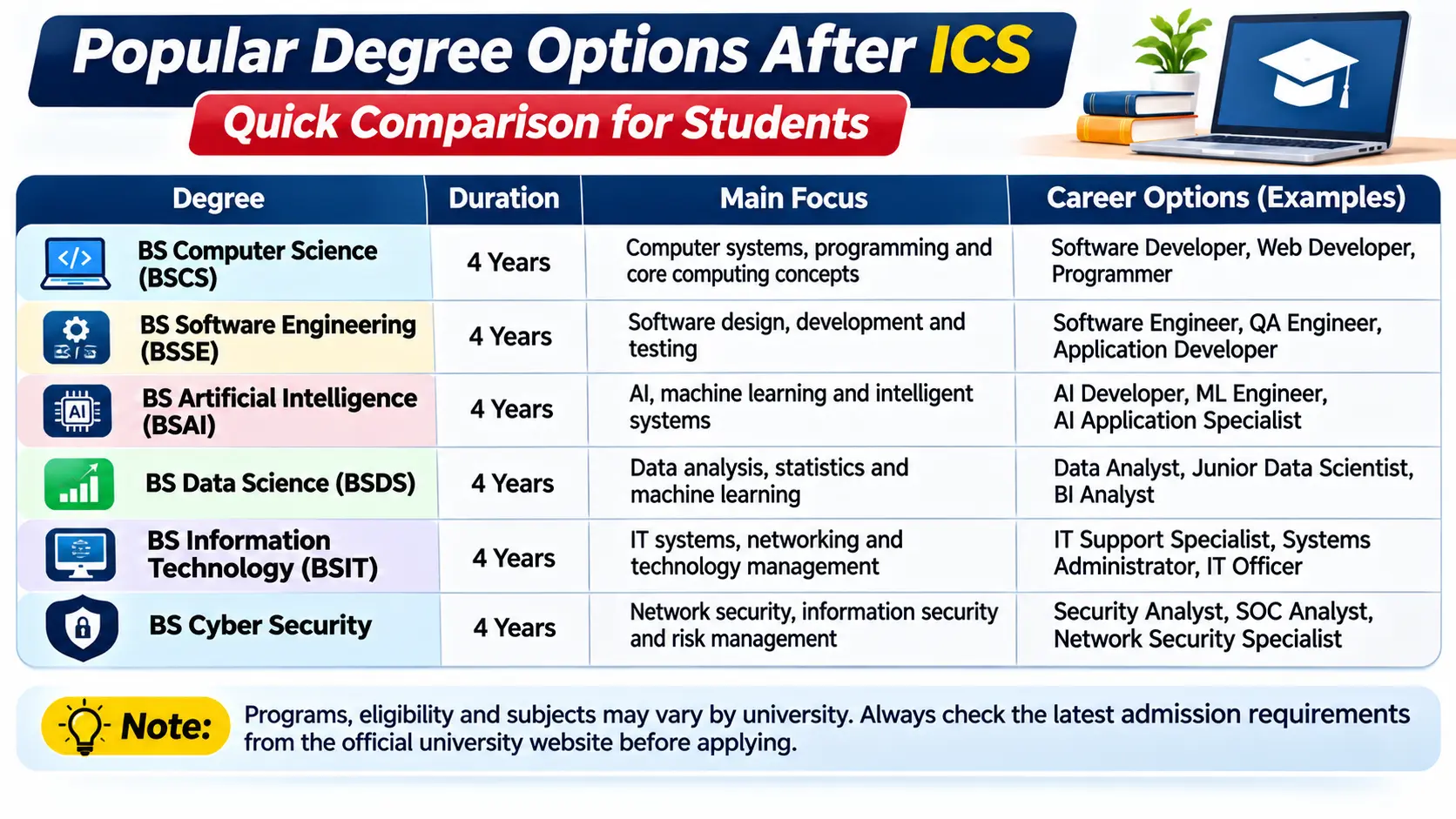
The following table compares popular options for students who have completed ICS.
| Degree / Course | Typical Duration | Main Focus | Possible Career Paths |
|---|---|---|---|
| BS Computer Science (BSCS) | 4 years | Programming, algorithms, computing | Software developer, programmer, systems developer |
| BS Software Engineering (BSSE) | 4 years | Software design and development | Software engineer, QA engineer, application developer |
| BS Information Technology (BSIT) | 4 years | IT systems and infrastructure | IT support, systems administrator, IT specialist |
| BS Artificial Intelligence (BSAI) | 4 years | Machine learning and AI | AI developer, ML engineer, AI application specialist |
| BS Data Science (BSDS) | 4 years | Statistics, programming, data analysis | Data analyst, junior data scientist |
| BS Cyber Security | 4 years | Network and information security | Security analyst, SOC analyst |
| BS Information Systems | 4 years | Technology and business processes | Business systems analyst, IT business analyst |
| BS Mathematics | 4 years | Mathematical methods and analysis | Analyst, teaching, research |
| BS Statistics | 4 years | Statistical analysis and research | Data analyst, research assistant |
| BBA | 4 years | Business and management | Marketing, sales, business operations |
| BS Accounting & Finance | 4 years | Accounting and financial management | Accounts assistant, finance analyst |
| Eligible Engineering Degrees | Usually 4 years | Applied engineering | Engineering roles subject to programme requirements |
These are typical programme durations and examples of possible careers, not guarantees of employment.
Some universities may offer different degree titles or structures. Admission eligibility also varies.
1. BS Computer Science (BSCS)
BS Computer Science is one of the most flexible degree options after ICS for students interested in technology.
A BSCS degree teaches the principles of computing and how software and computer systems work.
It generally provides a broad foundation that allows graduates to explore several areas of the technology industry.
What Will You Study in BSCS?
Common subjects include:
- Programming Fundamentals
- Object-Oriented Programming
- Data Structures and Algorithms
- Database Systems
- Operating Systems
- Computer Networks
- Software Engineering
- Artificial Intelligence
- Discrete Mathematics
- Final-Year Project
The actual curriculum varies between universities.
Career Opportunities After BSCS
Graduates may pursue careers such as:
- Software Developer
- Web Developer
- Mobile Application Developer
- Backend Developer
- Database Developer
- Systems Programmer
- Quality Assurance Engineer
- Technical Support Engineer
Additional learning and professional experience may open opportunities in cloud computing, cybersecurity, artificial intelligence, and other specializations.
Who Should Choose BSCS?
BSCS is worth considering if you enjoy programming, problem-solving, mathematics, and learning how computers work.
It is particularly useful if you haven’t yet decided which technology specialization to pursue.
Our recommendation: For many ICS students, BSCS is a sensible first choice because it provides a broad computing foundation instead of focusing on one specialized field from the beginning.
However, the quality of the university, programme accreditation, teaching, and your practical skills matter considerably.
2. BS Software Engineering (BSSE)
Software Engineering focuses on developing, testing, maintaining, and managing software applications.
While BSCS covers a broad range of computing concepts, BS Software Engineering generally places more structured emphasis on the software development lifecycle.
Common Subjects in Software Engineering
- Programming
- Software Requirements Engineering
- Software Design and Architecture
- Software Quality Assurance
- Software Testing
- Database Management
- Software Project Management
- Web and Mobile Development
- Final-Year Software Project
Career Options
Possible job roles include:
- Software Engineer
- Frontend Developer
- Backend Developer
- Mobile App Developer
- Software QA Engineer
- Automation Tester
- Software Support Engineer
BSCS vs Software Engineering: Which Is Better?
Neither is automatically better for everyone.
BSCS offers a broad computing education, while BSSE is more specifically organized around software engineering practices.
Both can lead to software development careers.
If you want to explore several computing fields, BSCS may provide more flexibility.
If you’re particularly interested in building, testing, and managing software systems, BSSE may suit your interests.
For example, FAST-NUCES officially lists Mathematics at HSSC level among the eligibility requirements for its BS Software Engineering programme.
Always check the programme-specific admission criteria.
3. BS Artificial Intelligence (BSAI)
Artificial Intelligence is a specialized computing field focused on developing systems that perform tasks involving prediction, classification, language processing, and other forms of intelligent computation.
AI has attracted considerable interest among Pakistani students because of developments in generative AI, automation, and machine learning.
However, choosing AI simply because it is trending is risky.
A serious AI degree requires mathematical and programming ability.
Common Subjects in BS Artificial Intelligence
- Programming Fundamentals
- Data Structures
- Linear Algebra
- Probability and Statistics
- Machine Learning
- Artificial Intelligence
- Deep Learning
- Natural Language Processing
- Computer Vision
- AI Projects
Career Opportunities
Graduates may work toward roles such as:
- Junior AI Developer
- Machine Learning Engineer
- AI Application Developer
- Data Analyst
- AI Research Assistant
- Software Developer
Some advanced research and machine learning roles may require additional education or significant specialized experience.
Is BS AI a Good Choice After ICS?
Yes, if you enjoy mathematics, coding, experimentation, and working with data.
But it is not necessarily the best first choice for every beginner.
If you’re unsure about your specialization, a strong BSCS programme with AI electives or projects may be a more flexible alternative.
Remember: Learning to use AI tools is different from studying the mathematics and programming required to develop AI systems.
4. BS Data Science (BSDS)
Data Science involves collecting, cleaning, analyzing, and interpreting data.
Organizations use data analysis to understand customer behaviour, operational performance, financial trends, and many other business problems.
A Data Science degree usually combines programming, mathematics, statistics, and computational methods.
Common Subjects
- Statistics
- Probability
- Python Programming
- Data Structures
- Database Systems
- Data Visualization
- Machine Learning
- Data Mining
- Linear Algebra
Career Opportunities
Potential careers include:
- Junior Data Analyst
- Business Intelligence Analyst
- Data Science Associate
- Reporting Analyst
- Analytics Engineer Trainee
- Research Data Assistant
Who Should Choose Data Science?
Students who enjoy mathematics, statistics, logical thinking, and working with numbers may find this field suitable.
However, students who strongly dislike mathematics should not choose Data Science solely because the field appears popular.
Practical skills in SQL, Python, Excel, data visualization, and problem-solving are particularly valuable.
5. BS Information Technology (BSIT)
Information Technology focuses on the practical use, management, and support of computer systems and technology infrastructure.
It can include networking, databases, information systems, web technologies, and IT operations.
Subjects You May Study
- Introduction to Computing
- Programming
- Computer Networks
- Database Management
- Information Security
- Systems Administration
- Web Technologies
- IT Project Management
Career Opportunities
Graduates may pursue roles such as:
- IT Support Specialist
- Network Support Technician
- Systems Administrator Trainee
- IT Operations Associate
- Technical Support Engineer
- Junior Database Administrator
BSIT vs BSCS
BSCS generally provides deeper coverage of computing theory, algorithms, and software concepts.
BSIT generally emphasizes implementing and managing technology systems.
There is significant overlap, and the actual difference depends on the university’s curriculum.
Our recommendation: Choose BSIT when you have a genuine interest in networking, systems, IT operations, or business technology. Don’t select it merely because you assume there will be no programming or mathematics.
6. BS Cyber Security
Cyber Security focuses on protecting networks, systems, applications, and information from unauthorized access and security threats.
It includes both technical and organizational aspects of information security.
Common Subjects
- Computer Networks
- Operating Systems
- Information Security
- Cryptography
- Network Security
- Digital Forensics
- Secure Programming
- Security Monitoring
- Ethical Hacking Fundamentals
Career Opportunities
Graduates may pursue positions such as:
- Junior Security Analyst
- Security Operations Centre (SOC) Analyst
- Network Security Associate
- Information Security Assistant
- Vulnerability Assessment Trainee
Advanced penetration testing and specialized security positions normally require additional practical training and experience.
Who Should Choose Cyber Security?
This field can suit students who enjoy troubleshooting, computer networks, security concepts, and technical investigation.
Practical labs and real problem-solving are essential.
Always practise security testing only in authorized environments.
7. BS Information Systems
Information Systems connects computer technology with organizational and business needs.
Unlike a degree focused mainly on building software, this programme may place more emphasis on understanding how technology supports business processes.
Subjects You May Study
- Database Management
- Systems Analysis and Design
- Business Processes
- Information Systems Management
- Programming
- Enterprise Systems
- Project Management
Career Opportunities
Possible roles include:
- Business Systems Analyst
- IT Business Analyst
- ERP Support Associate
- Information Systems Officer
- Technical Project Coordinator
This can be a useful option for students interested in both technology and business operations.
8. BS Mathematics and BS Statistics
Not every ICS student needs to choose a computing degree.
Students who enjoy mathematics, quantitative reasoning, and analysis can also consider Mathematics or Statistics.
BS Mathematics
This programme studies mathematical theory, problem-solving, and applied mathematics.
Possible areas include:
- Calculus
- Linear Algebra
- Differential Equations
- Numerical Methods
- Mathematical Modelling
Graduates may pursue further study, education-related careers, or analytical roles that require additional skills.
BS Statistics
Statistics focuses on collecting, analysing, and interpreting data.
Common subjects include:
- Probability
- Statistical Inference
- Regression Analysis
- Sampling Methods
- Statistical Computing
- Research Methods
Career Opportunities
Depending on further qualifications and skills, graduates may pursue careers in:
- Data Analysis
- Research
- Statistical Assistance
- Business Analytics
- Education
- Risk Analysis
Our recommendation: BS Mathematics and Statistics can be good choices when you genuinely enjoy quantitative subjects. Strengthening programming and data analysis skills can broaden career opportunities.
9. Business Degrees After ICS
ICS students are not necessarily restricted to technology-related degrees.
Many universities accept eligible Intermediate students into business and social science programmes.
Examples include:
Bachelor of Business Administration (BBA)
BBA covers management, marketing, finance, human resources, and business operations.
It may suit students interested in entrepreneurship, management, sales, and organizational work.
BS Accounting & Finance
This degree focuses on financial accounting, financial reporting, taxation fundamentals, and financial management.
It may suit students interested in business numbers, bookkeeping, and finance.
BS Economics
Economics studies economic behaviour, markets, policy, and resource allocation.
Students comfortable with mathematics and analytical reasoning may find it useful.
Career Options
Depending on the degree and skills, graduates may pursue roles such as:
- Marketing Executive
- Business Operations Assistant
- Accounts Assistant
- Junior Financial Analyst
- Sales Coordinator
- Research Assistant
NUST, for example, lists business studies and social science admission routes that accept different HSSC subject combinations.
However, requirements vary by institution and programme.
10. Can ICS Students Apply for Engineering in Pakistan?
Yes, some ICS students can apply for engineering programmes, but their subject combination and the university’s requirements are important.
A common misconception is that ICS students are completely ineligible for engineering.
That is not universally correct.
NUST’s official admissions guidance states that applicants who studied Physics, Mathematics, and Computer Science at the HSSC level are eligible to apply for its engineering programmes under the relevant PEC regulation.
Such students must complete Chemistry as a remedial course during the first semester after admission.
FAST-NUCES also lists ICS with Computer Science, Mathematics, and Physics as an accepted combination for certain engineering programmes, subject to its specific marks and test requirements.
What If You Studied Statistics Instead of Physics?
Do not assume you qualify for the same engineering programmes.
If your ICS combination was Mathematics, Statistics, and Computer Science, you must check the individual programme’s eligibility rules.
Some computing programmes may remain available even when a particular engineering programme is not.
Computing Degree vs Engineering Degree
A BS Software Engineering degree offered as a computing programme is not automatically the same as a PEC-accredited engineering qualification.
Students should check whether the specific programme is accredited by NCEAC, PEC, or another relevant body.
This distinction can matter for professional recognition and future employment requirements.
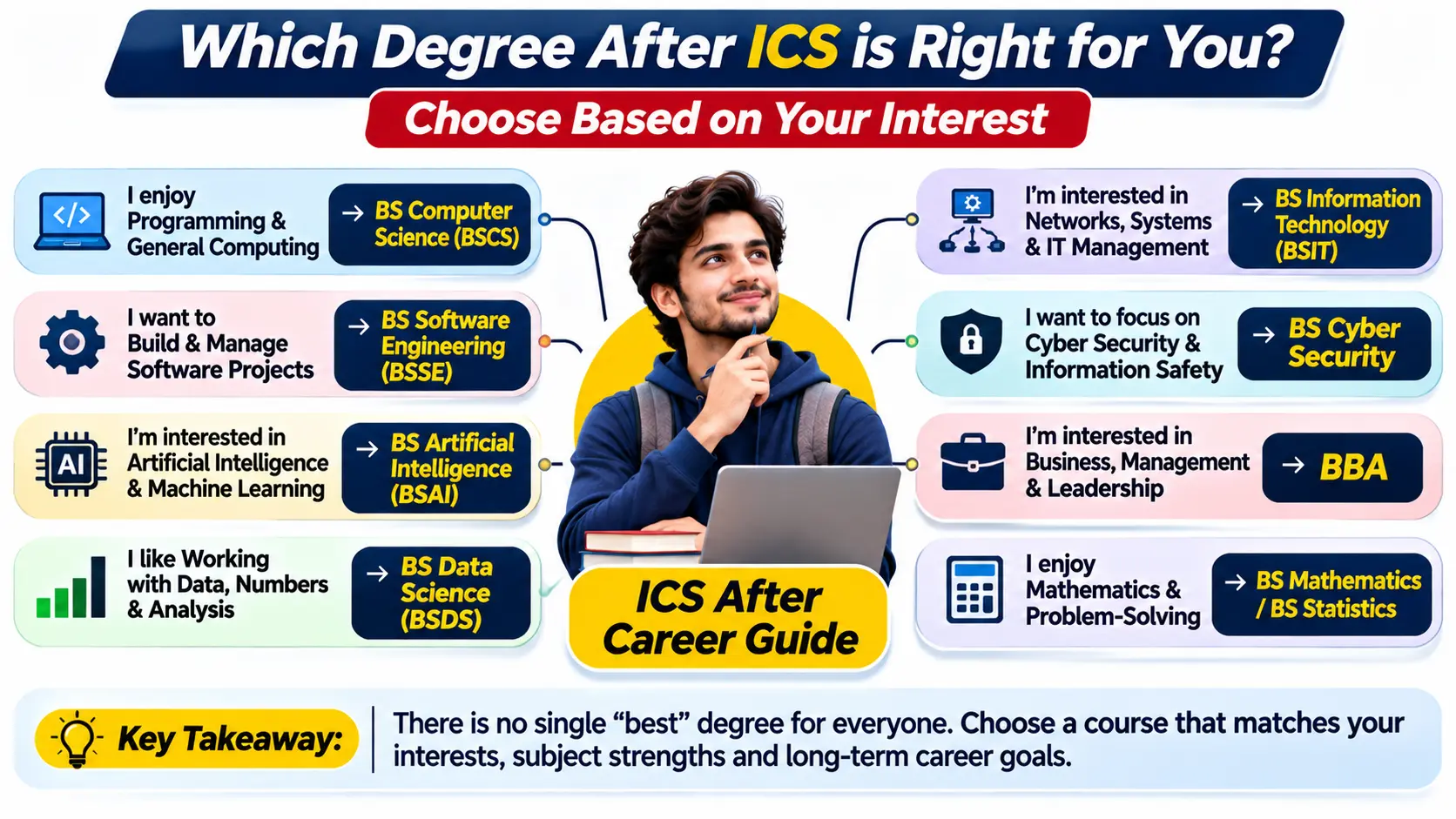
Best Degree After ICS: Which One Should You Choose?
There is no single best degree for every ICS student.
A better decision depends on your interests and academic strengths.
| Your Interest | Degree Worth Considering |
|---|---|
| General programming and broad computing | BS Computer Science |
| Building and testing software | BS Software Engineering |
| Machine learning and intelligent systems | BS Artificial Intelligence |
| Mathematics and analysing data | BS Data Science or BS Statistics |
| Networks, systems, and IT management | BS Information Technology |
| Information and network security | BS Cyber Security |
| Technology combined with business | BS Information Systems |
| Business and management | BBA |
| Accounting and finance | BS Accounting & Finance |
| Mathematics and research | BS Mathematics |
| Engineering with Physics background | Eligible engineering programmes |
Our Practical Recommendation
For a student who likes computing but is undecided about specialization, BS Computer Science is a strong default to investigate first.
It offers exposure to programming, algorithms, databases, operating systems, and other foundational subjects.
However, a well-taught and properly accredited BSIT, BSSE, BSAI, or BSDS programme may be a better decision than a weak BSCS programme.
University quality and your actual skills should carry more weight than a fashionable degree title.
Admission Requirements for Courses After ICS
Admission requirements are not identical across universities.
Factors may include:
- HSSC marks
- Matric marks
- Relevant Intermediate subjects
- Admission test scores
- Programme-specific eligibility
- Merit lists
- Available seats
How Much Percentage Is Required After ICS?
It depends on the university and degree.
For example, FAST-NUCES’s published 2026 eligibility criteria for computing programmes include at least 60% marks in SSC, at least 50% in HSSC, and Mathematics at HSSC level.
Its engineering programmes have different eligibility requirements.
NUST uses a separate admission test and merit system.
Therefore, 50% marks is not a universal admission guarantee, and an applicant may still fall below a university’s final merit cutoff.
Before applying, check the official university admission advertisement for your intended session.
Best Universities for ICS Students in Pakistan
Several Pakistani universities offer computing and related undergraduate programmes.
Examples worth researching include:
| University | Location / Study Options |
|---|---|
| National University of Sciences and Technology (NUST) | Islamabad and relevant campuses |
| FAST National University (FAST-NUCES) | Multiple campuses |
| COMSATS University Islamabad | Islamabad and authorized campuses |
| Information Technology University (ITU) | Lahore |
| University of the Punjab | Lahore and authorized campuses |
| University of Engineering and Technology (UET) | Lahore and relevant campuses |
| GIKI | Topi, Swabi |
| Air University | Islamabad and authorized campuses |
| Virtual University of Pakistan | Online/distance-learning model with authorized arrangements |
This is a research shortlist, not a ranking of university quality.
The programmes offered, campus eligibility, accreditation status, and admissions change over time.
How to Check HEC Recognition
Before paying admission fees:
- Visit the official Higher Education Commission website.
- Check whether the university is recognized.
- Verify that the specific campus is authorized.
- Confirm that your intended degree programme is offered at that campus.
- Check programme accreditation with the relevant accreditation council.
- Review the current admission requirements and fee schedule.
You can use the official HEC Recognized Universities list.
What Is NCEAC Accreditation?
The National Computing Education Accreditation Council (NCEAC) is responsible for accreditation of relevant computing degree programmes in Pakistan.
Its scope includes programmes such as Computer Science, Software Engineering, Information Technology, Artificial Intelligence, Data Science, and Cyber Security.
HEC recognition of a university and NCEAC accreditation of a particular computing programme are separate checks.
A university may be recognized while the accreditation status of an individual programme or intake requires separate verification.
Visit NCEAC’s official website to check accreditation information.
How Much Does a Degree After ICS Cost in Pakistan?
University expenses depend on multiple factors:
- Public or private university
- Degree programme
- Campus location
- Tuition fee per semester
- Admission and registration charges
- Laboratory or other academic fees
- Transportation or hostel costs
- Annual fee increases
It would be misleading to give one fee range and claim it applies to all universities in Pakistan.
A public university may cost significantly less than some private universities, but fee structures and financial assistance vary.
How to Calculate Your Total Education Cost
Before enrolling, estimate:
Total cost = Admission charges + semester fees + examination/lab charges + transport or accommodation + other necessary expenses.
For a four-year programme, calculate the expected cost across all eight semesters and allow for possible fee increases.
Ask the university for its latest official fee schedule and scholarship information.
Career Scope After ICS in Pakistan
Students often ask which degree has the highest salary or most job opportunities.
There is no reliable answer that applies to every graduate.
Your future earning potential can depend on:
- Technical skills
- University education quality
- Portfolio and practical projects
- Internships
- City and employer
- Communication ability
- Experience
- Specialization
- Local and international market conditions
For example, two BSCS graduates from the same university can have very different career outcomes because of their actual skills and experience.
Can ICS Students Become Freelancers?
Yes.
Students can learn practical skills while pursuing a degree.
Examples include:
- Web Development
- Graphic Design
- Video Editing
- WordPress Development
- Data Analysis
- Mobile Application Development
- UI/UX Design
However, freelancing is not guaranteed income. Finding clients, delivering quality work, handling revisions, and managing payments require sustained effort.
A degree can provide a useful foundation, but clients usually also expect evidence of your work.
Skills ICS Students Should Learn During University
Whatever degree you choose, developing practical skills can improve your career readiness.
1. Programming Fundamentals
For computing students, begin with a language used in your coursework, such as Python, C++, or Java.
Focus on understanding programming concepts rather than memorizing syntax.
2. Problem-Solving
Learn how to break problems into smaller steps, test solutions, and identify mistakes.
3. English Communication
Many technical resources, client communications, and workplace documents use English.
You do not need perfect English, but clear communication is valuable.
4. Git and Version Control
For software-related careers, understanding Git and collaborative development workflows is useful.
5. Databases and SQL
Database knowledge is valuable in software development, data analytics, and several business technology roles.
6. Practical Projects
Create projects that demonstrate what you have learned.
For example, a student could build:
- A simple expense tracker
- A student record management application
- A portfolio website
- A small data analysis dashboard
- A basic inventory system
7. Internship Experience
Apply for relevant internships when you have enough foundational skills.
An internship can help you understand workplace expectations and build professional connections.
Mistakes to Avoid When Choosing a Course After ICS
Choosing a Degree Only Because It’s Trending
AI, data science, and cybersecurity may sound attractive, but specialized programmes require serious effort.
Choose a field that matches your interests and abilities.
Ignoring Programme Accreditation
Don’t assume that every degree advertised by an institution has the same recognition or accreditation status.
Assuming a Degree Guarantees Employment
No degree automatically guarantees a job.
Academic performance, skills, projects, internships, and market conditions matter.
Selecting a University Without Checking Costs
Consider the total cost of completing the programme, not only the first-semester fee.
Ignoring Your ICS Subject Combination
Students who studied Statistics instead of Physics may face different eligibility requirements for some programmes.
Focusing Only on Salary
Salary is important, but you should also consider whether you can build strong skills in the chosen field.
Waiting Until Graduation to Build Skills
Start learning practical skills and creating projects during your studies.
Can You Get a Job Directly After ICS?
Yes, some entry-level positions and training opportunities may accept candidates with Intermediate qualifications.
Possible opportunities include:
- Data Entry Operator
- Office Assistant
- Computer Operator Trainee
- Customer Support Representative
- Retail and Administrative Assistant
- Junior Digital Services Assistant
However, some positions require additional training, typing ability, software proficiency, or specific qualifications.
For a long-term professional computing career, a recognized degree or a well-structured technical training pathway is often worth considering.
If university education is not financially possible immediately, students can also explore affordable training, scholarships, and entry-level work while continuing to develop their skills.
Frequently Asked Questions (FAQs)
1. What are the best courses after ICS in Pakistan?
Popular options include BS Computer Science, BS Software Engineering, BS Information Technology, BS Artificial Intelligence, BS Data Science, and BS Cyber Security. Students may also consider Mathematics, Statistics, business degrees, and eligible engineering programmes.
2. Which degree is best after ICS?
BS Computer Science is a flexible option for students who enjoy computing but have not decided on a specialization. However, the best choice depends on your interests, eligibility, university quality, and career goals.
3. Can I do BS Software Engineering after ICS?
Yes. Eligible ICS students can apply to Software Engineering programmes. Universities generally assess HSSC subjects, marks, entrance tests, and other admission requirements.
4. Can ICS students apply for engineering?
Yes, in certain cases. NUST allows applicants with Physics, Mathematics, and Computer Science to apply for its engineering programmes, subject to the relevant rules and a Chemistry remedial course. Requirements vary by university.
5. Can I study Artificial Intelligence after ICS?
Yes, if you meet the university’s eligibility requirements. AI involves programming, mathematics, statistics, and machine learning.
6. Is BSCS better than BSIT?
Neither is automatically better. BSCS typically emphasizes broader computing foundations, while BSIT generally focuses more on applied information technology. Compare the actual university curricula.
7. Can I do BBA after ICS?
Yes, many universities offer business programmes to eligible students from different HSSC backgrounds. Check the institution’s current admission requirements.
8. Can ICS students study Data Science?
Yes. Mathematics is an important foundation for Data Science, but students must meet the specific university’s admission criteria.
9. How many years is BSCS after ICS?
BS Computer Science is typically a four-year undergraduate programme comprising eight semesters.
10. Is 50% enough for BSCS admission?
Some universities publish 50% as part of their minimum HSSC eligibility criteria. Others may have different requirements. Meeting the minimum does not guarantee admission, especially where final merit is competitive.
11. Which university is best for Computer Science in Pakistan?
There is no universally best university for every student. Consider recognition, programme accreditation, faculty, curriculum, facilities, cost, location, and graduate outcomes.
12. Is Cyber Security a good career after ICS?
It can be suitable for students interested in networking, operating systems, technical investigation, and information security. Practical learning and further specialization are important.
13. Can I do freelancing after ICS?
Yes. Freelancing depends on marketable skills and the ability to deliver client work, not only on holding a university degree.
14. Can ICS students apply for government jobs?
Yes, where they meet the qualifications and other requirements of a particular vacancy. Some jobs accept Intermediate qualifications, while others require a degree.
15. What should I do if I cannot afford a university degree?
Explore public universities, financial assistance, scholarships, affordable recognized programmes, and vocational training. Compare the full cost and quality before enrolling.
Conclusion
Choosing the best course after ICS in Pakistan requires understanding your interests, academic strengths, admission eligibility, and long-term career plans.
For students interested in technology, BS Computer Science, Software Engineering, Information Technology, Artificial Intelligence, Data Science, and Cyber Security are important options to explore.
Students who prefer mathematics, statistics, business, or management can also consider degrees outside traditional computing.
Some ICS students may qualify for engineering programmes, particularly when they have studied Physics and Mathematics, subject to specific university requirements.
Before taking admission, always verify HEC recognition, relevant programme accreditation, the latest eligibility criteria, and total education costs.
Most importantly, remember that choosing a degree is only the beginning. Practical skills, internships, projects, and consistent learning will also shape your future opportunities.
For more education and university admission guides, explore EduRozgar’s Education section.
Official Sources and Useful Links
- Higher Education Commission — Recognized Universities and Institutions
- HEC — Recognized University Campuses
- HEC — Undergraduate Education Policy
- National Computing Education Accreditation Council (NCEAC)
- FAST-NUCES — Undergraduate Admission Eligibility Criteria
- NUST — ICS Students’ Eligibility for Engineering
- NUST — Undergraduate Admission Merit Criteria
- Pakistan Engineering Council (PEC)
Last Updated: November 9, 2026
Disclaimer: EduRozgar is an independent educational information website and is not affiliated with HEC, NCEAC, PEC, or any university. Admission eligibility, fees, programme availability, accreditation, and merit requirements can change. Always verify current information directly with the university and relevant regulatory authorities before applying.