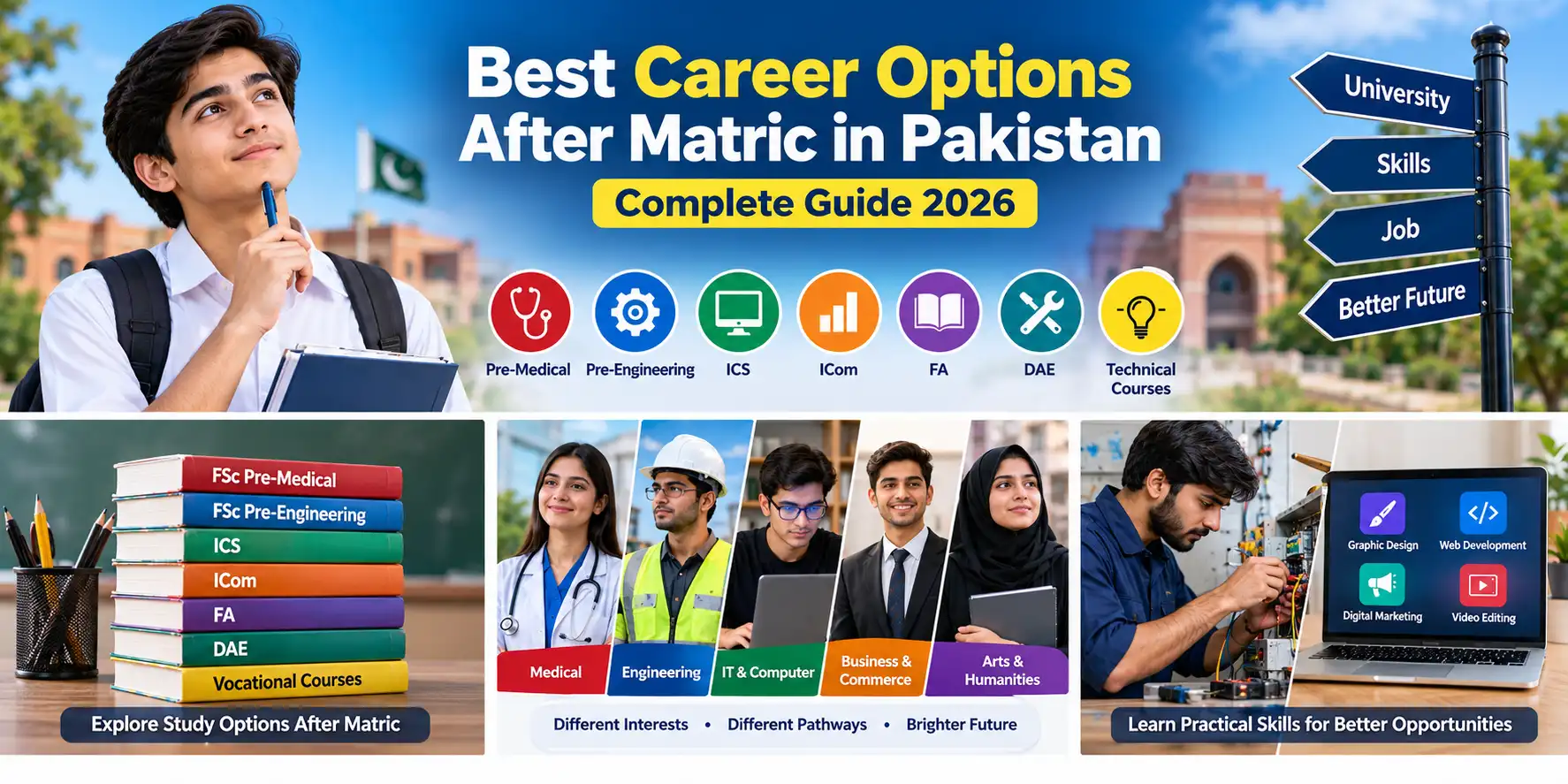
Best Career Options After Matric in Pakistan – Complete Guide 2026
Choosing the right career after Matric is one of the most important educational decisions for students in Pakistan. After completing the 10th class, many students feel confused about whether to select FSc, ICS, FA, ICom, DAE, or a technical diploma.
Some students want to become doctors or engineers, while others are interested in computers, business, freelancing, teaching, or practical technical work. There is no single educational path that is suitable for everyone.
The best career options after Matric in Pakistan depend on your interests, academic performance, financial situation, and long-term goals.
In this guide, we will explore the major study options after Matric, compare their advantages, explain possible career paths, and help you make an informed decision about your future.
What to Do After Matric in Pakistan?
After passing Matriculation (SSC), students in Pakistan can continue their education through several academic and technical pathways.
The most common options include:
- FSc Pre-Medical
- FSc Pre-Engineering
- ICS (Intermediate in Computer Science)
- ICom (Intermediate in Commerce)
- FA (Intermediate in Arts or Humanities)
- DAE (Diploma of Associate Engineering)
- Technical and Vocational Training
- Short Computer and Digital Skills Courses
Each pathway develops different skills and can lead to further studies or employment opportunities.
For example, students interested in medicine may choose FSc Pre-Medical, while those interested in programming may prefer ICS. Students who enjoy working with machines and electrical equipment may consider a recognized technical diploma.
Before choosing any field, it is important to understand what you will study and which qualifications may be required for your intended future degree or profession.
Best Study Options After Matric in Pakistan
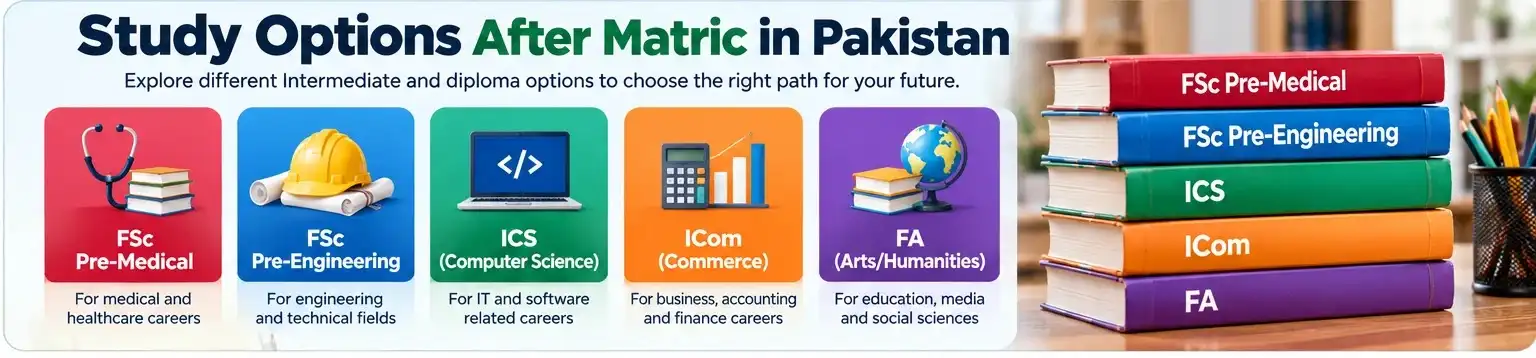
1. FSc Pre-Medical – For Students Interested in Healthcare
FSc Pre-Medical is a popular option for students who want to pursue careers related to medicine, healthcare, or biological sciences.
The program generally includes Biology, Chemistry, Physics, and compulsory subjects.
Who should choose FSc Pre-Medical?
This field may be suitable for students who:
- Enjoy studying Biology and Chemistry.
- Are interested in human health and medical sciences.
- Want to pursue healthcare-related university programs.
- Are comfortable with science-based academic study.
Possible future career paths:
- Medicine (MBBS)
- Dentistry (BDS)
- Nursing
- Pharmacy
- Medical Laboratory Sciences
- Biotechnology
- Nutrition and Dietetics
- Other health and biological science fields
Students should understand that completing FSc Pre-Medical does not automatically qualify them for admission to MBBS or BDS. Admission requirements may include entry tests, minimum marks, merit criteria, and other conditions set by the relevant authorities.
For example, admission to a four-year Bachelor of Science in Nursing generally requires an FSc Pre-Medical or equivalent qualification meeting the applicable standards.
Career advice: Choose Pre-Medical because you are genuinely interested in healthcare and science, not simply because relatives or friends expect you to become a doctor.
2. FSc Pre-Engineering – For Future Engineering Students
FSc Pre-Engineering is designed for students interested in Mathematics, Physics, engineering, and technology.
The major subjects typically include Mathematics, Physics, and Chemistry.
Who should choose FSc Pre-Engineering?
This field is suitable for students who:
- Enjoy Mathematics and problem-solving.
- Want to understand how machines and structures work.
- Are interested in engineering and applied sciences.
- Prefer technical and analytical subjects.
Possible future career paths:
- Electrical Engineering
- Mechanical Engineering
- Civil Engineering
- Chemical Engineering
- Mechatronics
- Mathematics and Physics
- Other relevant technology programs
Engineering university admission depends on the requirements of each institution and relevant professional accreditation rules.
Career advice: Good mathematical skills are valuable in engineering. If you strongly dislike Mathematics, carefully consider whether this field matches your strengths.
3. ICS – For Students Interested in Computers and Technology
ICS stands for Intermediate in Computer Science. It is an attractive option for students interested in computers, software, programming, and information technology.
Subject combinations may vary depending on the board or college, but typically include Computer Science and Mathematics with another approved elective.
Who should choose ICS?
ICS may suit students who:
- Enjoy using computers.
- Want to learn programming.
- Are interested in websites, software, or technology.
- Like logical thinking and solving problems.
Possible future career paths:
- Computer Science
- Software Engineering
- Information Technology
- Cybersecurity
- Data Science
- Artificial Intelligence
- Web and Mobile Application Development
Admission to a specific university degree depends on the program’s eligibility requirements. Not every subject combination is accepted by every institution.
Skills students can start learning during ICS:
- Python programming
- HTML, CSS, and JavaScript
- Basic computer networking
- Microsoft Excel
- Graphic design
- English communication
Students should remember that learning computer skills takes regular practice. Simply choosing ICS does not guarantee an IT job.
Career advice: ICS can be a suitable pathway if you enjoy technology and are willing to keep learning.
4. ICom – For Business, Accounting and Commerce Careers
ICom stands for Intermediate in Commerce.
It introduces students to important concepts related to business, accounting, economics, and commercial activities.
Who should choose ICom?
ICom may be suitable for students who:
- Are interested in business and finance.
- Like accounting and financial calculations.
- Want to explore banking or commerce.
- Are considering running a business in the future.
Possible future career paths:
- Business Administration
- Accounting and Finance
- Commerce
- Banking
- Entrepreneurship
- Business Operations
- Professional accounting qualifications, subject to their entry requirements
Useful additional skills:
- Microsoft Excel
- Bookkeeping
- Business communication
- Basic accounting software
- Digital marketing
- Financial literacy
Career advice: ICom is worth considering if you enjoy business-related subjects. However, successful careers in finance and accounting usually require further education, professional development, or relevant experience.
5. FA – For Humanities, Social Sciences and Creative Fields
FA is an Intermediate-level pathway that generally offers subjects from humanities, arts, and social sciences.
Available subject combinations depend on the college and educational board.
Who should choose FA?
FA may suit students who:
- Enjoy writing, languages, and social sciences.
- Are interested in teaching, communication, or public service.
- Prefer humanities subjects over laboratory sciences.
- Want to explore media or creative disciplines.
Possible future career paths:
- Education and Teaching
- Media and Communication
- Languages and Literature
- Social Sciences
- Public Administration
- Design and Creative Fields
- Other degree programs for which the student meets eligibility criteria
FA students can also develop valuable practical skills such as content writing, graphic design, communication, and digital marketing.
Career advice: FA is not automatically an inferior qualification. Its usefulness depends on the subjects selected, future degree requirements, and the skills students develop.
DAE After Matric – A Technical Education Pathway
What Is DAE?
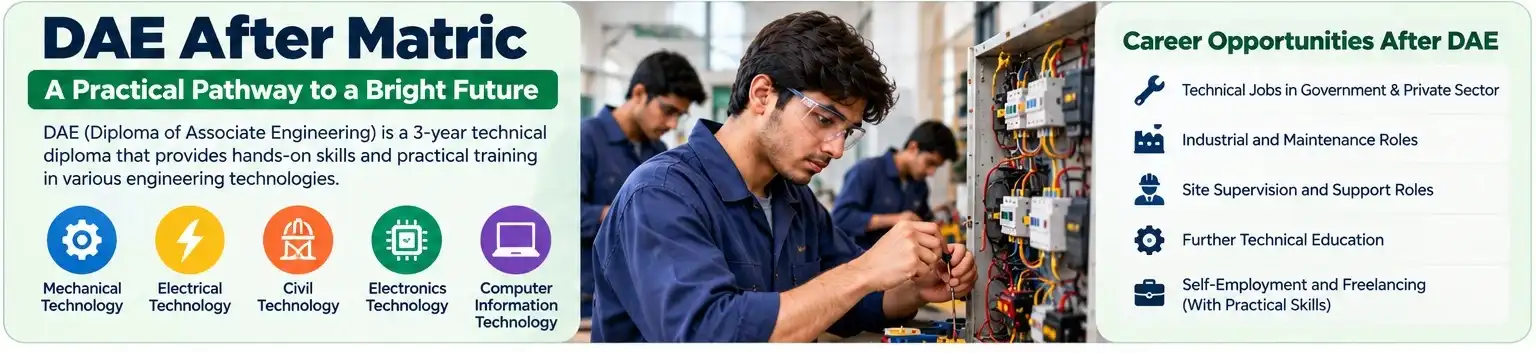
DAE stands for Diploma of Associate Engineering. It is generally a three-year technical diploma undertaken after Matriculation by students who meet the relevant admission requirements.
Unlike a purely academic pathway, DAE places substantial emphasis on technical knowledge and practical training.
Common DAE disciplines include:
- Electrical Technology
- Mechanical Technology
- Civil Technology
- Electronics Technology
- Computer Information Technology
- Other approved technical specializations
The disciplines available depend on the institute and its examining board.
Who Should Choose DAE?
DAE may be suitable for students who:
- Enjoy practical work.
- Are interested in machines, electrical systems, or construction.
- Want to learn technical skills through structured training.
- Prefer laboratory and workshop activities alongside theoretical study.
Career Opportunities After DAE
Depending on specialization and employer requirements, DAE graduates may pursue:
- Technician positions
- Technical support roles
- Industrial maintenance work
- Site supervision support
- Electrical or mechanical workshop roles
- Further technical education
- Relevant university programs where their diploma is accepted
Important: DAE is a technical diploma, not a Bachelor’s engineering degree. It does not automatically make someone a registered professional engineer.
Students should verify the institute’s affiliation, technical board, diploma recognition, and further-study eligibility before enrolling.
Short Courses and Vocational Training After Matric
Not every student can immediately afford an extended academic program. Some students want practical skills to improve their employment opportunities while continuing their education.
Vocational training can be useful in these situations.
Popular Technical Skills
Examples include:
- Electrician Training
- Solar Panel Installation
- Refrigeration and Air Conditioning
- Mobile Phone Repair
- Automobile Maintenance
- Welding and Fabrication
- Plumbing
- Tailoring and Dressmaking
- Culinary Skills
These skills may lead to technician roles, apprenticeships, local services, or self-employment. Earnings depend on proficiency, location, market demand, equipment, and experience.
Computer and Digital Skills
Students can also explore:
- Graphic Design
- Web Development
- Video Editing
- Digital Marketing
- Search Engine Optimization (SEO)
- Microsoft Office
- E-Commerce Support
- Basic Programming
Online courses can help students understand these skills, but creating a portfolio and completing practical projects are equally important.
Where to Find Technical Training in Pakistan
Students can explore programs offered by recognized vocational training bodies and institutions.
NAVTTC: The National Vocational and Technical Training Commission supports skills development and vocational qualifications in Pakistan.
Official Website: https://navttc.gov.pk
TEVTA: Provincial Technical Education and Vocational Training Authorities provide technical and vocational education through their respective institutions.
For Punjab, students can visit:
Students should check individual program eligibility, age requirements, application periods, training fees, and certificate recognition. Not every course is free or open to every Matric student.
Career Options After Matric – Comparison Table
The following table provides a general comparison of common educational pathways.
| Study Option | Typical Duration | Best Suited For | Future Direction |
|---|---|---|---|
| FSc Pre-Medical | 2 years | Biology and healthcare | Medical and health sciences |
| FSc Pre-Engineering | 2 years | Mathematics and engineering | Engineering and applied sciences |
| ICS | 2 years | Computers and programming | Computing and IT |
| ICom | 2 years | Business and accounting | Commerce and finance |
| FA | 2 years | Humanities and languages | Education, arts and social sciences |
| DAE | 3 years | Practical technical work | Technical employment and further study |
| Vocational Courses | Varies | Specific hands-on skills | Skill-based work |
| Digital Skills Courses | Varies | Technology and creative services | Portfolio-based opportunities |
Note: Durations are general. Actual eligibility, course content, recognition, and progression pathways depend on the examining board, training provider, and institution.
Which Field Is Best After Matric for Students in Pakistan?
There is no universally best field. A suitable pathway depends on what a student enjoys and what they want to achieve.
If You Want to Become a Doctor
FSc Pre-Medical is the conventional academic route to consider, followed by the relevant admission and entry-test requirements.
If You Want to Become an Engineer
Consider FSc Pre-Engineering and check the requirements of your target engineering degree. DAE can be another technical pathway, but progression requirements differ.
If You Want to Become a Software Developer
ICS can provide a useful academic foundation. Learn programming through projects and check university admission requirements.
If You Want to Work in Business or Banking
ICom can introduce commerce-related subjects. Further education and practical accounting or financial skills may be needed.
If You Prefer Creative or Humanities Subjects
FA may be suitable, depending on your subject combination and intended higher-education program.
If You Want Practical Technical Skills
Consider an appropriately recognized DAE program, apprenticeship, or vocational training course.
If Your Goal Is Freelancing
You can begin learning digital skills alongside your formal education. Freelancing is a way of providing services to clients, not a guaranteed profession or fixed-income scheme.
Best Career Options After Matric for Students With Limited Budgets
Financial limitations can influence educational decisions, but a low-cost option should still provide recognized learning and reasonable future opportunities.
Students with limited budgets may consider:
- Applying to public-sector colleges that offer their preferred Intermediate program.
- Exploring government technical institutes and recognized vocational centers.
- Looking for merit-based or need-based financial assistance.
- Learning foundational digital skills through reputable free resources.
- Exploring apprenticeships with genuine training and reasonable working conditions.
Before accepting any admission offer, compare the total costs, including tuition, examination fees, books, travel, accommodation, and equipment.
A program that appears inexpensive initially may become costly if travel or materials are not included.
Students should also avoid paying agents who promise guaranteed employment after a short course.
How to Choose the Right Career After Matric

Choosing a field becomes easier when you follow a structured process.
Step 1: Identify Your Interests
Think about which subjects you enjoy most.
Do you prefer Biology, Mathematics, computers, writing, business, or practical technical activities?
Your interests are an important starting point, although they should not be the only factor.
Step 2: Evaluate Your Academic Strengths
Consider your marks and understanding of relevant subjects.
For example, a student interested in engineering should realistically assess their preparation in Mathematics.
Good marks are helpful, but motivation, learning habits, and access to support also matter.
Step 3: Research Future Qualifications
Identify the education required for your intended career.
If you want to become a software engineer, nurse, teacher, or accountant, investigate the relevant degree or professional qualification requirements before choosing your Intermediate subjects.
Step 4: Compare Institutions and Costs
Check the institution’s recognition, facilities, teachers, admission conditions, and affordability.
Do not select a college solely because friends are applying there.
Step 5: Speak to Knowledgeable People
Consult teachers, career counselors, professionals working in your preferred field, and family members.
Try to speak with people who understand both the benefits and difficulties of a particular career.
Step 6: Make a Two-Year Learning Plan
After choosing your field, set practical goals.
For example:
- Maintain consistent academic performance.
- Improve written and spoken English.
- Develop basic computer skills.
- Explore suitable extracurricular activities.
- Research future admissions before the final examination year.
This will help you prepare for opportunities beyond Intermediate education.
Five Common Mistakes Students Make After Matric
1. Choosing a Field Only Because Friends Choose It
Your friends may have different abilities, goals, and financial circumstances. Their preferred field may not be the right one for you.
2. Assuming Science Is Always Better Than Arts or Commerce
Every field has different opportunities and limitations. A student’s performance and long-term development matter more than social labels attached to subjects.
3. Ignoring Admission Eligibility
Some university programs require specific subjects, minimum marks, or entry tests. Choosing the wrong combination can restrict later options.
4. Trusting Guaranteed-Earning Advertisements
Be cautious of institutes or online courses promising immediate jobs, guaranteed freelancing income, or unusually high salaries.
5. Ignoring Practical Skills
Regardless of your academic field, communication, computer literacy, problem-solving, and professional discipline can support your future career.
Frequently Asked Questions About Career Options After Matric
1. What is the best field after Matric in Pakistan?
There is no single best field. FSc, ICS, ICom, FA, DAE, and vocational training can all be suitable depending on your interests, abilities, and career goals.
2. Is ICS a good option after Matric?
ICS can be a useful choice for students interested in computing, programming, and technology. Students should confirm subject combinations and university eligibility requirements.
3. Can I become a doctor after Matric?
Matric alone is not sufficient for admission to an MBBS program. Students typically need the relevant higher secondary qualification and must satisfy current medical admission requirements.
4. Is DAE better than FSc?
Neither is automatically better. DAE generally emphasizes technical and practical training, while FSc provides an academic pathway to relevant university programs. Your intended career should guide the choice.
5. Can Arts students have successful careers?
Yes. Humanities students can pursue education, communication, social sciences, public administration, and other eligible degree pathways. Further qualifications and skills are often important.
6. Can I earn money online after Matric?
Students can learn digital skills and explore legitimate work opportunities, subject to age, platform, and legal requirements. Earning is not guaranteed and usually requires substantial practice.
7. Which course is useful for freelancing after Matric?
Graphic design, web development, video editing, writing, and digital marketing are potential choices. The best skill depends on your abilities, interest, and willingness to practice.
8. Can I apply for government jobs after Matric?
Some government vacancies accept Matric-level qualifications. However, applicants must meet the age limit, domicile conditions, and other requirements of each recruitment notice.
Looking for employment opportunities? Explore the latest government and private job updates in our Jobs section.
9. Are there free technical training programs in Pakistan?
Government-supported vocational training opportunities may be available through organizations such as NAVTTC. Eligibility, enrollment dates, and availability depend on the particular program.
10. How can I choose a career if I am still confused?
Start by comparing your interests, strongest subjects, financial situation, and desired careers. Speak to teachers or qualified counselors, and research the exact education requirements before making a final decision.
Conclusion
Choosing among the best career options after Matric in Pakistan requires more than following popular trends.
FSc Pre-Medical can provide a foundation for health-related studies, FSc Pre-Engineering supports engineering-oriented education, ICS offers a pathway toward computing, ICom introduces commerce, and FA supports a wide range of humanities-related directions.
DAE and vocational programs can also be valuable for students interested in technical training and practical skills.
The right choice is one that matches your interests, meets the requirements of your future goals, and remains realistic for your circumstances.
Before enrolling, verify the institution’s recognition, admission criteria, total costs, and progression opportunities.
Your career is not decided by one examination result. The choices you make, the skills you develop, and the effort you put into your education will continue to shape your opportunities.
For more educational guides, skills training information, career advice, and employment updates in Pakistan, visit EduRozgar.com.
Disclaimer: This article provides general educational and career guidance. Admission requirements, program recognition, fees, and eligibility conditions may change. Always confirm the latest information with the relevant educational board, institution, or regulatory body before applying.