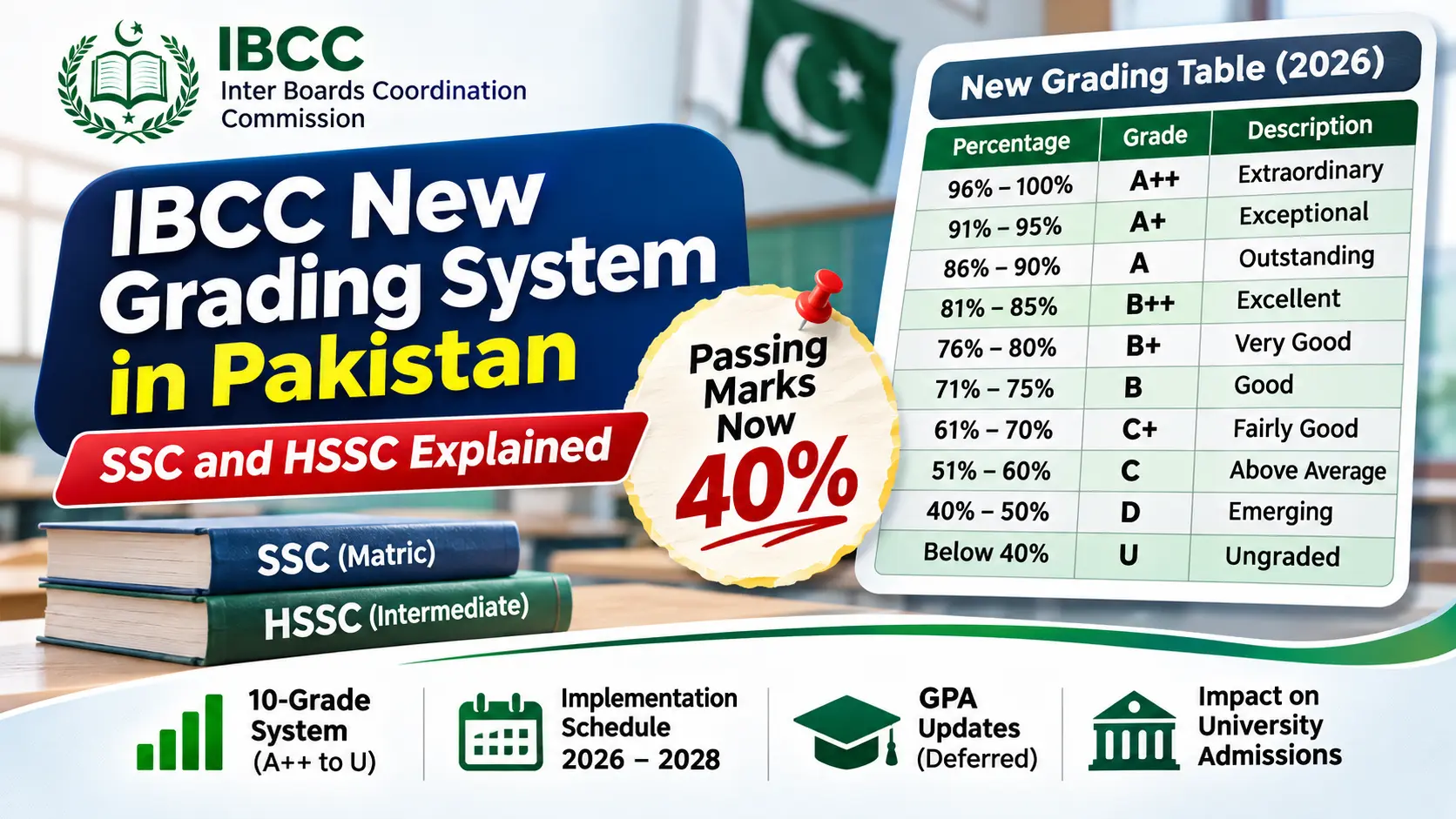
IBCC New Grading System in Pakistan: SSC and HSSC Explained
Pakistan’s examination system is undergoing an important change. The Inter Boards Coordination Commission (IBCC) has introduced a new grading policy for Secondary School Certificate (SSC) and Higher Secondary School Certificate (HSSC) examinations.
The biggest changes include a new 10-grade system and an increase in minimum passing marks from 33% to 40%.
The policy began rolling out in 2026, with implementation taking place in phases. However, not every examination board has completed the transition, so students must check the rules applicable to their own board.
If you’re studying in Class 9, 10, 11, or 12, understanding the new system can help you interpret your results and prepare for future examinations.
In this guide, we’ll explain the IBCC new grading system in Pakistan, including the official grading table, passing marks, implementation schedule, GPA changes, and what students should know about university admissions.
What Is the IBCC New Grading System?
The IBCC new grading system is a revised method of reporting students’ academic performance in Matric and Intermediate examinations.
Previously, Pakistan’s examination boards generally used a seven-grade structure consisting of A-1, A, B, C, D, E, and F.
The revised policy introduces ten grades:
A++, A+, A, B++, B+, B, C+, C, D, and U.
The new system aims to reduce excessive competition for individual marks and provide a more detailed assessment of students’ performance.
Instead of focusing only on numerical scores, the policy gradually moves toward grade-based academic reporting.
However, this transition is taking place in stages. Numerical marks are still being reported during the initial implementation period.
According to IBCC, full adoption of the grading policy is planned by 2028.
IBCC New Grading System 2026: Official Grading Table
The Federal Board of Intermediate and Secondary Education (FBISE) issued a notification on October 7, 2025, confirming the revised grading formula.
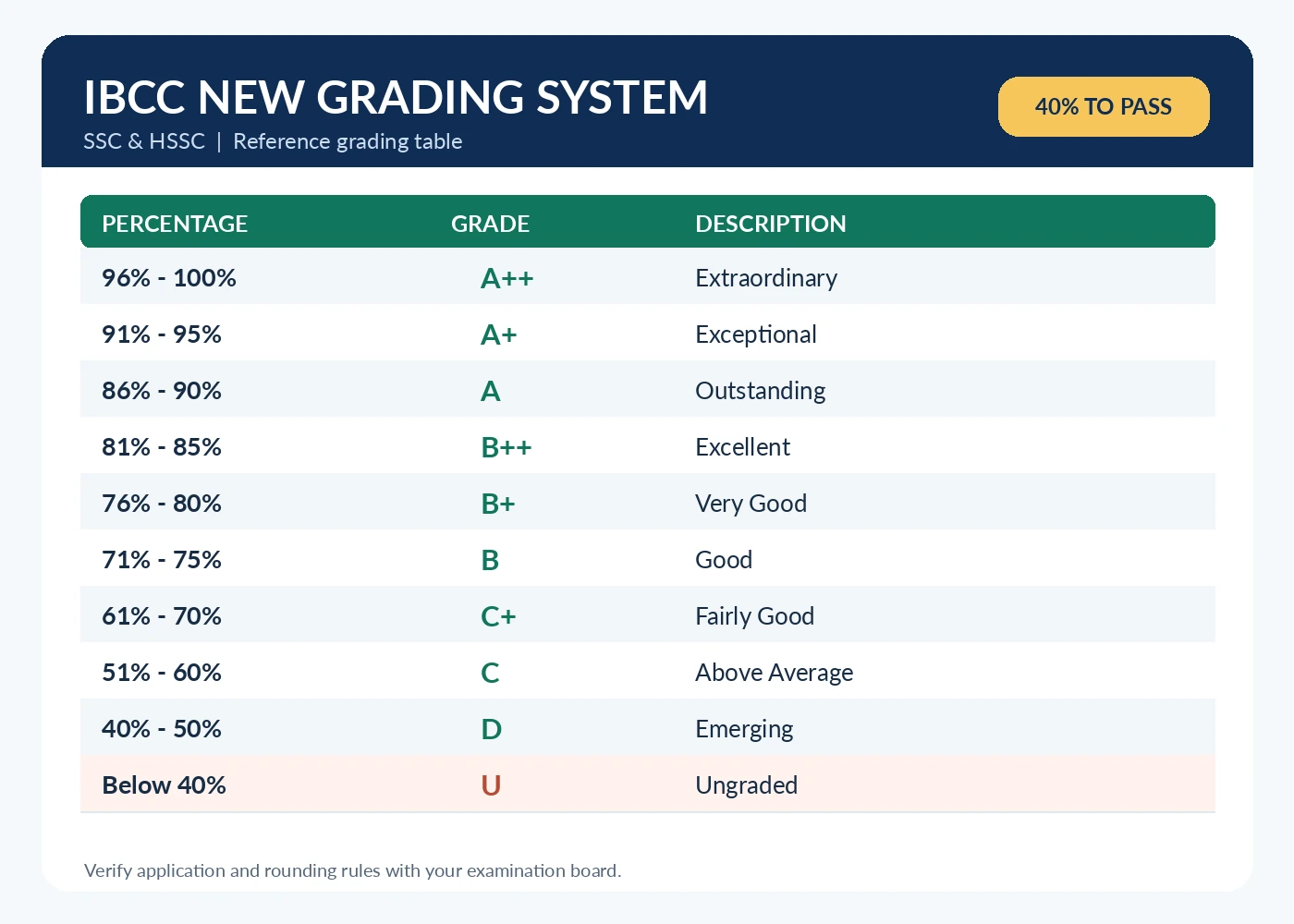
The following table shows the notified percentage ranges, grades, and descriptions.
| Marks Percentage | Grade | Description |
|---|---|---|
| 96%–100% | A++ | Extraordinary |
| 91%–95% | A+ | Exceptional |
| 86%–90% | A | Outstanding |
| 81%–85% | B++ | Excellent |
| 76%–80% | B+ | Very Good |
| 71%–75% | B | Good |
| 61%–70% | C+ | Fairly Good |
| 51%–60% | C | Above Average |
| 40%–50% | D | Emerging |
| Below 40% | U | Ungraded |
Source: FBISE Revised Grading Formula — Official Notification (PDF)
Examples of Grades Under the New System
To understand the table, consider these examples:
- A student scoring 98% receives A++.
- A student scoring 92% receives A+.
- A student scoring 87% receives A.
- A student scoring 82% receives B++.
- A student scoring 78% receives B+.
- A student scoring 73% receives B.
- A student scoring 65% receives C+.
- A student scoring 55% receives C.
- A student scoring 45% receives D.
- A student scoring 35% receives U.
These examples use whole-number percentages. Students with decimal percentages near a grade boundary should follow their examination board’s official rounding and grading rules.
New Passing Marks in Pakistan: 33% or 40%?
One of the most important changes is the increase in minimum passing marks.
Under the previous system, the general passing requirement was 33%.
Under the revised grading system, the minimum passing requirement is 40%.
| Grading System | Passing Percentage |
|---|---|
| Previous system | 33% |
| New IBCC system | 40% |
This means students appearing under the revised policy must meet the new passing requirement.
How Many Marks Are Required to Pass?
The number of marks needed depends on the total marks allocated to the subject.
| Total Marks | 40% Passing Marks |
|---|---|
| 50 | 20 |
| 75 | 30 |
| 100 | 40 |
| 150 | 60 |
| 200 | 80 |
These are mathematical examples. Students should follow their board’s actual subject-wise passing and assessment rules.
What Happens If You Score Below 40%?
Under the revised grading formula, students who score below 40% in a paper receive a U grade, which stands for Ungraded.
According to the FBISE notification, eligible students receiving a U grade must reappear in the relevant paper.
For example, if a student receives:
- English: 72% — B
- Mathematics: 38% — U
- Physics: 80% — B+
- Chemistry: 65% — C+
The student meets the revised passing threshold in three subjects but not in Mathematics.
The applicable reappearance process, examination schedule, and eligibility requirements depend on the relevant examination board.
IBCC New Grading System Implementation Schedule
The grading policy is being introduced gradually across Pakistan.
According to the official IBCC FAQ, the phased implementation began with the first annual examinations of 2026, with full national adoption planned by 2028.
Class-Wise Implementation
| Year | Implementation Stage |
|---|---|
| 2026 | Class 9 (SSC-I) and Class 11 (HSSC-I) |
| 2027 | Class 10 (SSC-II) and Class 12 (HSSC-II) |
| 2028 | Planned completion of the nationwide transition |
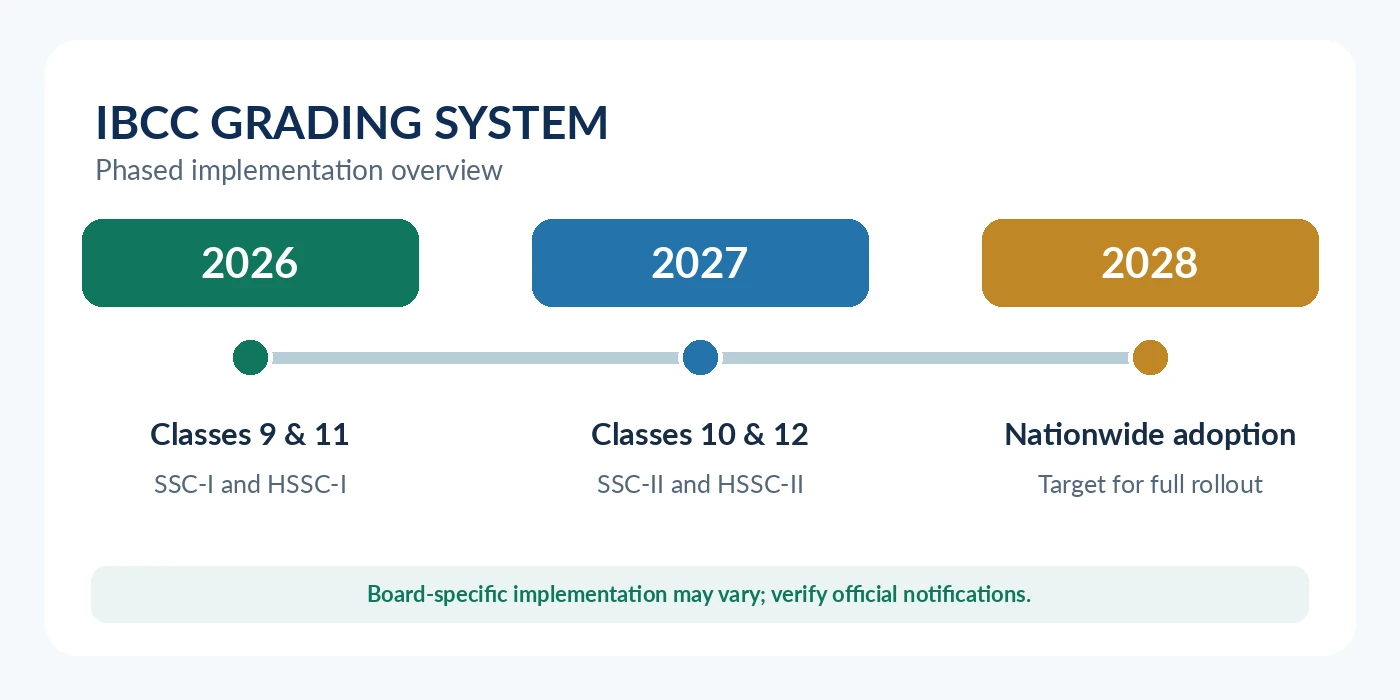
The FBISE notification specifically confirms the 2026 rollout for SSC-I and HSSC-I and the 2027 rollout for SSC-II and HSSC-II.
Is the New Grading System Implemented Across All Boards?
Not completely.
Although IBCC has established a national implementation framework, adoption has progressed at different speeds across examination boards.
According to reports from the 184th IBCC Forum in September 2026, the new grading policy had been implemented by several boards, including:
- Federal Board (FBISE)
- Examination boards in Sindh
- AJK Board
- Karakoram International University Board
- Aga Khan University Examination Board
- Ziauddin University Examination Board
The national transition was still ongoing.
Important Note: Students of Lahore, Gujranwala, Faisalabad, Multan, Rawalpindi, and other provincial boards should confirm the applicable grading and passing rules through their own board’s official notifications.
Do not assume that every board has implemented the same phase at exactly the same time.
New SSC Grading System for Matric Students
SSC stands for Secondary School Certificate and covers Class 9 and Class 10.
The new grading policy affects how academic performance is classified and reported.
Class 9 Grading System
Under the IBCC implementation plan, the revised policy began with SSC-I examinations in 2026.
Students appearing under the new system are assessed using the revised grade categories and the 40% passing requirement.
Class 10 Grading System
The FBISE rollout schedule specifies the first annual examinations of 2027 for SSC-II.
Students appearing through other boards should verify whether the same schedule has been officially adopted.
Example of SSC Subject Grades
Consider a hypothetical student with these results:
| Subject | Percentage | Grade |
|---|---|---|
| English | 82% | B++ |
| Mathematics | 91% | A+ |
| Physics | 74% | B |
| Chemistry | 88% | A |
| Biology | 66% | C+ |
This table is an illustration of subject-wise grading, not an official result card.
New HSSC Grading System for Intermediate Students
HSSC stands for Higher Secondary School Certificate and covers Class 11 and Class 12.
It includes different educational groups, such as:
- FSc Pre-Medical
- FSc Pre-Engineering
- ICS
- I.Com
- FA
The revised grading structure is intended for both SSC and HSSC examinations.
Class 11 Grading System
Under the phased framework, HSSC-I implementation began in 2026.
Class 12 Grading System
The FBISE implementation notification specifies the first annual examinations of 2027 for HSSC-II.
Other boards may publish their own implementation instructions.
Does the New Policy Change FSc or ICS Subjects?
No. The grading change does not automatically change the subjects included in FSc, ICS, I.Com, or FA.
IBCC’s official FAQ states that the revised grading policy does not itself change the curriculum or examination paper pattern.
Students should continue following the syllabus and assessment instructions issued by their boards.
Old Grading System vs New Grading System
Here is a comparison of the previous and revised grading systems.
| Feature | Old System | New System |
|---|---|---|
| Grade categories | 7 | 10 |
| Highest grade | A-1 | A++ |
| Lowest grade | F | U |
| Minimum passing percentage | 33% | 40% |
| Academic reporting | Marks and grades | Transition toward grade-based reporting |
| Implementation | Earlier board rules | Phased rollout from 2026 |
The main difference is not simply the introduction of new grade names.
The revised policy also raises the passing standard and introduces a more detailed grading structure.
Will Marks Be Removed from Result Cards?
Many students have heard that numerical marks will disappear under the new grading system.
This is part of the longer-term transition, but it does not mean that every result card immediately stopped showing marks in 2026.
According to IBCC’s official FAQ, numerical scores continue to be reported alongside grades during the initial implementation period.
This helps students, teachers, parents, and admission authorities understand the revised system.
The eventual objective is to move toward standardized reporting using grades and grade points.
However, students must follow the reporting format issued by their respective examination boards.
What Is GPA in the New IBCC Grading System?
GPA stands for Grade Point Average.
It is a method of representing academic performance through grade points rather than relying only on percentage marks.
The IBCC grading reforms are intended to support a gradual shift toward GPA-based academic reporting.
However, IBCC has deferred GPA reporting until the revised grading policy has been adopted across examination boards.
Can Students Calculate Their GPA Now?
Students can identify their letter grades using the applicable grading table.
However, they should not treat an unofficial online GPA calculator as an official board result.
Grade points, calculation methods, and final reporting formats must be confirmed through the relevant examination authority.
If your board has not issued an official GPA, avoid presenting an estimated GPA as your confirmed academic result.
Will the New Grading System Affect University Admissions?
The revised policy may affect how universities evaluate academic performance in the future.
Traditionally, many Pakistani universities have used SSC and HSSC marks, percentages, entrance tests, and other eligibility requirements when selecting applicants.
According to IBCC’s guidance, universities may continue referring to raw marks or use grades during the transition.
IBCC anticipates a longer-term move toward CGPA-based admission assessment after nationwide adoption of the revised system.
However, individual universities determine their admission requirements according to applicable regulations.
What Should Students Do Before Applying?
Students planning university admissions should:
- Read the latest admission advertisement.
- Confirm the minimum academic eligibility requirements.
- Check whether the university uses percentages, grades, or entrance test scores.
- Follow the relevant program’s admission criteria.
- Contact the admission office if their result card uses a different grading format.
For example, an FSc Pre-Medical student applying to a medical program must still meet the relevant admission and regulatory requirements.
The grading policy does not automatically remove other eligibility conditions.
Does the New Grading System Change Exam Papers?
No. IBCC’s official FAQ states that the new grading policy does not itself change:
- Examination paper patterns
- Marking arrangements
- Examination difficulty
- Curriculum requirements
- Examination administration
Students should continue preparing according to their board’s official syllabus and examination guidance.
Any separate assessment reforms or model-paper updates should be checked independently.
What Happens to Improvement Exam Students?
Some students reappear in examinations to improve previous results.
The new grading policy includes transitional arrangements, meaning the revised formula may not apply in the same way to every improvement or reappearance candidate.
IBCC’s official FAQ identifies cases where older grading rules remain applicable.
Students considering improvement examinations should confirm:
- Which grading formula applies to their attempt
- Whether the revised passing percentage applies
- The registration requirements
- The examination fee
- The result and certificate reporting rules
Students should obtain confirmation from their board rather than relying on unofficial social media posts.
Why Did IBCC Introduce the New Grading System?
According to IBCC, the revised grading policy aims to improve academic assessment and reduce unnecessary pressure associated with competing for individual marks.
1. Reducing Competition for Marks
The policy aims to shift attention away from small differences in numerical marks.
2. Providing More Performance Categories
The new ten-grade structure provides more detailed classifications of academic performance.
3. Standardizing Grading
A common grading framework is intended to improve consistency across domestic examination boards.
4. Supporting Modern Assessment Practices
The reforms are part of wider efforts to improve how student achievement is assessed and reported.
These are the intended benefits of the policy. Their practical impact will depend on implementation and how schools, universities, and examination boards use the new system.
How Should Students Prepare for the New Grading System?
The revised passing requirement makes consistent exam preparation particularly important.
Here are some practical suggestions.
Understand Concepts Instead of Memorizing Answers
Focus on understanding the subject material so you can answer questions in different formats.
Practice with Model Papers
Use model papers and assessment materials issued by your examination board.
Identify Weak Subjects
If you regularly score below 40% in practice tests, give those subjects additional attention.
Follow a Study Schedule
Divide your study time among subjects and revise regularly rather than leaving everything until the final weeks.
Check Official Board Updates
Follow official announcements for changes in examination schedules, grading rules, or result reporting.
Common Misunderstandings About the New Grading System
Misunderstanding 1: Every board implemented the new grading system fully in 2026.
The national rollout is phased, and implementation has varied across boards.
Misunderstanding 2: Students no longer receive marks.
Numerical marks continue to be reported during the initial transition, according to IBCC.
Misunderstanding 3: Scoring 33% is enough under the new policy.
The revised passing threshold is 40% for examinations covered by the new system.
Misunderstanding 4: A student with 39% receives a D grade.
No. Under the revised grading table, below 40% falls in the U category.
Misunderstanding 5: Every student can calculate an official GPA immediately.
The nationwide transition to GPA reporting is not complete.
Misunderstanding 6: The grading policy makes examination papers more difficult.
IBCC states that the revised grading system does not itself change examination difficulty.
Frequently Asked Questions (FAQs)
1. What is the IBCC new grading system in Pakistan?
It is a revised ten-grade system for SSC and HSSC examinations, using grades A++, A+, A, B++, B+, B, C+, C, D, and U.
2. What are the new passing marks in Pakistan?
The minimum passing requirement under the revised grading policy is 40%, compared with 33% under the previous standard.
3. When did the IBCC new grading system start?
The national phased implementation began with the first annual examinations of 2026 for Class 9 and Class 11.
4. Does the new grading system apply to Class 10 in 2027?
The FBISE notification specifies implementation for SSC-II from the first annual examinations of 2027. Students of other boards should verify their applicable schedules.
5. What grade is 80% in the new grading system?
According to the notified FBISE table, 80% corresponds to B+, described as Very Good.
6. What grade is 90%?
A score of 90% corresponds to A, described as Outstanding.
7. What does U mean in the new grading system?
U means Ungraded. It applies to scores below 40% under the revised formula.
8. Will marks still appear on result cards?
IBCC states that numerical scores continue to be reported alongside grades during the initial transition.
9. Does the new grading system apply to both SSC and HSSC?
Yes. The revised framework covers both Matric and Intermediate examinations, subject to implementation schedules.
10. Is the new grading system implemented in Punjab?
IBCC’s national policy covers examination boards across Pakistan, but implementation has progressed at different speeds. Punjab Board students should confirm the latest rules with their own BISE.
11. Will the new grading system affect university admissions?
It may change how academic results are considered over time. Students must continue following the admission criteria issued by their chosen universities.
12. Where can I check official IBCC grading updates?
Visit the official IBCC website or your examination board’s official website.
Conclusion
The IBCC new grading system in Pakistan is an important change for students appearing in SSC and HSSC examinations.
The revised policy introduces ten grade categories and increases the minimum passing percentage from 33% to 40%.
Implementation began in 2026 for Class 9 and Class 11 under the national phased framework, with Class 10 and Class 12 scheduled for 2027 under the FBISE notification. Full nationwide adoption is planned by 2028.
However, students should remember that implementation is not identical across every board.
Marks are still being reported during the initial transition, and GPA reporting remains subject to the wider implementation process.
The best approach is to understand the revised grading system, prepare according to your board’s syllabus, and regularly check official examination updates.
For more education news, exam updates, and student guides, explore the Results & Date Sheets section on EduRozgar.
Official Sources and References
- IBCC — New Grading System of SSC & HSSC: Official FAQs
- FBISE — Revised Grading Formula Notification, October 7, 2025 (PDF)
- IBCC — Official Website
- Associated Press of Pakistan — 184th IBCC Forum Implementation Update, September 2026
Last Updated: November 5, 2026
Disclaimer: This article is published for educational and informational purposes. Examination rules, implementation schedules, and grading procedures may vary by board and session. Students should verify all examination-related information through IBCC and their respective examination boards.
