Introduction
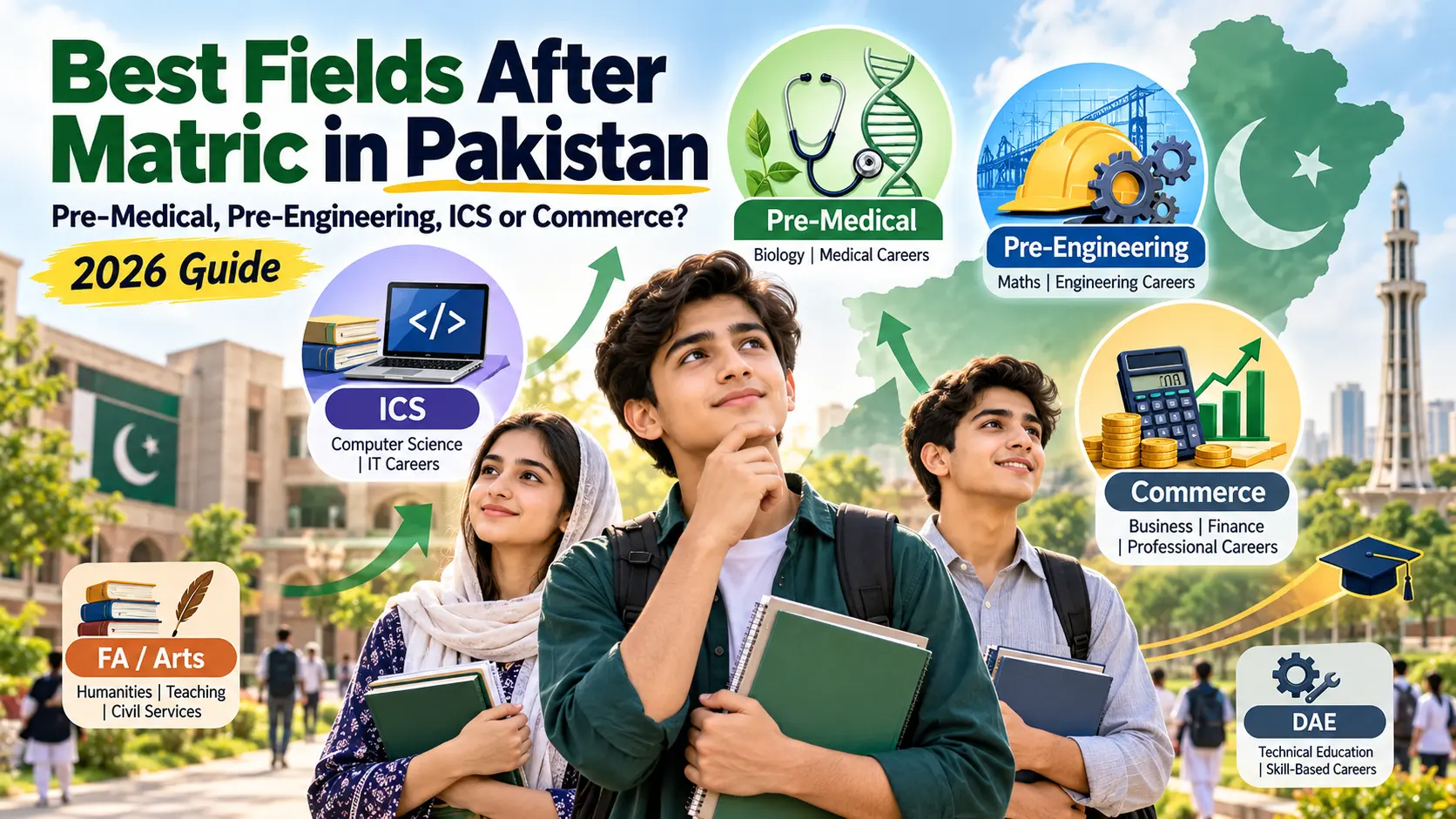
After matric, every student in Pakistan faces the same big question: which field should I choose? Pre-Medical, Pre-Engineering, ICS, Commerce or Arts? This one decision shapes your university options and, in many cases, your entire career.
Unfortunately, many students choose a field because of family pressure or because their friends are going there. Two years later, they realize the subjects do not suit them.
In this guide, we compare all the main options after matric in Pakistan: what you study, which careers each field leads to, which entry tests you will face, and how to pick the one that fits you best.
Quick Comparison of Fields After Matric
| Field | Main subjects | Leads to | Main entry test | Best for |
|---|---|---|---|---|
| FSc Pre-Medical | Biology, Chemistry, Physics | MBBS, BDS, Pharmacy, Nursing, DPT, Allied Health | MDCAT (for MBBS/BDS) | Students who love Biology and can handle hard study |
| FSc Pre-Engineering | Mathematics, Physics, Chemistry | Engineering, Computer Science, Architecture | ECAT, NUST NET | Students strong in Maths and Physics |
| ICS | Computer Science, Mathematics, Physics or Statistics | BS CS, Software Engineering, IT, Data Science | University tests (NTS, NUST, FAST etc.) | Students interested in computers and coding |
| I.Com | Accounting, Business Maths, Economics, Commerce | B.Com, BBA, CA, ACCA, Banking | Usually merit or university test | Students who like business and numbers |
| FA / Humanities | Choice of arts subjects (e.g. Psychology, Economics, Civics, Computer) | BS Psychology, Law, Mass Communication, English, CSS later | University test (varies) | Students interested in social sciences, writing, law |
| DAE (3-year diploma) | Technical subjects (Civil, Electrical, Mechanical etc.) | Sub-engineer jobs, B.Tech, BSc Engineering Technology | Technical board admission | Students who want practical skills and early jobs |
1. FSc Pre-Medical
Pre-Medical is the first choice for students who dream of becoming doctors. You study Biology, Chemistry and Physics in detail.
Career options after Pre-Medical:
- MBBS (doctor) and BDS (dentist)
- Doctor of Pharmacy (Pharm-D)
- Doctor of Physical Therapy (DPT)
- BS Nursing
- Medical Lab Technology, Radiology and other Allied Health Sciences
- BS Biotechnology, Microbiology, Zoology, Botany and Food Sciences
Entry test: Admission to MBBS and BDS requires the MDCAT, a national test conducted under the Pakistan Medical and Dental Council (PMDC). Merit is calculated as 10% matric marks, 40% FSc marks and 50% MDCAT score. Competition is very high: about 138,000 candidates registered for MDCAT 2026.
Choose Pre-Medical if: you genuinely enjoy Biology, can memorize a lot of material, and are ready for a long study path (MBBS takes 5 years plus house job).
Think twice if: you are choosing it only because of family pressure. Not everyone gets an MBBS seat, so keep backup options like Pharm-D, DPT or Allied Health in mind.
2. FSc Pre-Engineering
Pre-Engineering focuses on Mathematics, Physics and Chemistry. It is ideal for students with strong problem-solving skills.
Career options after Pre-Engineering:
- BSc Engineering (Civil, Electrical, Mechanical, Chemical, Software and more)
- BS Computer Science and Software Engineering
- Architecture
- BS Mathematics, Physics, Statistics
- Pakistan Army, Navy and PAF technical cadets
Entry tests: For public engineering universities in Punjab, UET Lahore conducts the ECAT (Engineering College Admission Test), which it has run since 1999. NUST holds its own test (NET), and other universities such as GIKI, PIEAS and FAST have separate tests.
Choose Pre-Engineering if: you enjoy Maths and Physics and like to understand how things work.
Bonus: Pre-Engineering keeps both engineering and computer science open, which makes it one of the most flexible options.
3. ICS (Intermediate in Computer Science)
ICS is for students who are interested in computers, technology and programming. Common subject combinations are Computer Science + Mathematics + Physics or Computer Science + Mathematics + Statistics.
Career options after ICS:
- BS Computer Science, Software Engineering, Information Technology
- BS Data Science, Artificial Intelligence, Cyber Security
- BS Mathematics or Statistics
- Freelancing and online work in web development, design and IT services
Engineering note: ICS with Physics can open some engineering programs, especially in computer and electrical-related fields, at certain universities. ICS with Statistics usually does not qualify for engineering. Always check each university’s eligibility criteria.
Choose ICS if: you like computers and want a career in the IT sector, which is one of Pakistan’s fastest-growing export industries.
If you want to earn online alongside studies, read our guide on how to start freelancing in Pakistan.
4. I.Com (Intermediate in Commerce)
I.Com is for students who are interested in business, finance and accounts. Subjects include Principles of Accounting, Business Mathematics, Economics, Principles of Commerce and Banking.
Career options after I.Com:
- B.Com, BBA, BS Accounting & Finance
- Professional qualifications: CA (Chartered Accountancy), ACCA, ICMA (Cost and Management Accounting)
- Banking, insurance and finance jobs
- Starting your own business or e-commerce store
Choose I.Com if: you are good with numbers, interested in how money and businesses work, and want a career in accounting, banking or business. Students aiming for CA or ACCA can start their professional studies right after intermediate.
Good to know: I.Com does not lead to medicine or engineering. If you are unsure, choose a field that keeps more doors open.
5. FA (Humanities / Arts)
FA lets you choose from a wide range of subjects such as Psychology, Economics, Civics, Education, Islamic Studies, Computer Science, Sociology and Fine Arts.
Career options after FA:
- BS Psychology, English, Mass Communication, International Relations, Sociology
- LLB (law) and a career as a lawyer
- Teaching and education
- Journalism, media and content creation
- Competitive exams like CSS and PMS after graduation
Choose FA if: you enjoy reading, writing, history and social issues, or want to become a lawyer, teacher, journalist or civil servant.
Myth: FA is not a “weak” choice. Many successful lawyers, civil servants and media professionals came through the humanities path.
6. DAE (Diploma of Associate Engineering)
DAE is a 3-year technical diploma offered by government and private polytechnic institutes, including TEVTA institutes in Punjab. Popular technologies include Civil, Electrical, Mechanical, Electronics, Computer, Chemical and Auto & Diesel.
Career options after DAE:
- Jobs as sub-engineer or technician in government and private sectors
- B.Tech / BSc Engineering Technology for higher studies
- Jobs abroad, especially in the Gulf, where skilled technicians are in demand
Choose DAE if: you prefer practical, hands-on work over theory and want to start earning sooner.
How to Choose the Right Field After Matric
Ask yourself these questions honestly before you decide:
- Which subjects did I enjoy most in matric? If you loved Biology, Pre-Medical makes sense. If Maths was your strength, Pre-Engineering or ICS may suit you better.
- What were my marks in key subjects? Strong marks in Science and Maths are important for Pre-Medical and Pre-Engineering, which are demanding fields.
- What career do I actually want? Work backwards. If you want to be a software developer, ICS or Pre-Engineering both work. If you want to be a lawyer, FA is enough.
- How long can I study? MBBS and engineering need 4 to 5 years of university after intermediate. DAE lets you start working sooner.
- Can my family support the cost? Private medical and engineering colleges are expensive. Look into government universities and scholarships early.
- Have I talked to people in that field? Speak to a doctor, engineer, accountant or software developer you know about their daily work.
Common Mistakes Students Make
- Choosing a field only because friends are taking it
- Picking Pre-Medical under pressure without interest in Biology
- Ignoring backup options if you don’t get into MBBS or engineering
- Thinking Arts or Commerce students cannot be successful
- Not preparing early for entry tests like MDCAT or ECAT
Tip: If you are confused between Pre-Medical and Pre-Engineering, ask yourself whether you prefer Biology or Mathematics. That single answer usually decides it.
Frequently Asked Questions (FAQs)
Which field has the most scope after matric in Pakistan? There is no single “best” field. Medicine, engineering and IT have strong demand, but accounting, law and technical diplomas also offer good careers. The best field is the one that matches your interest and ability.
Can ICS students apply for MBBS? No. MBBS and BDS require FSc Pre-Medical (or an equivalent with Biology).
Can Pre-Medical students do Computer Science? Some universities admit Pre-Medical students to BS CS if they pass additional Mathematics courses. Check the specific university’s policy.
Is ICS better than Pre-Engineering for computer science? Both lead to BS Computer Science. Pre-Engineering also keeps engineering open, while ICS gives you an earlier start in programming.
Which field is best for girls after matric? All fields are open to girls. Pre-Medical, ICS, Commerce and FA are all popular, and the choice should depend on interest, not gender.
Can I change my field after intermediate? In some cases yes, for example from Pre-Engineering to CS or business, but changing from Arts or Commerce to medicine or engineering is generally not possible.
Conclusion
Choosing a field after matric is one of the most important decisions of your life, but it does not have to be stressful. Pick Pre-Medical if you love Biology, Pre-Engineering if you are strong in Maths and Physics, ICS if computers excite you, I.Com if business and accounts interest you, FA if you enjoy social sciences, law or writing, and DAE if you prefer practical skills.
Listen to your parents and teachers, but make the final choice based on your own interest and strengths.
For admissions updates, results and date sheets, visit our Education and Results & Date Sheets sections. For more help planning your future, see Career Guidance.
